
Tattoo and piercing aftercare at Ink Fire, Mazatlán
What you do
in these two weeks
stays forever.
The session is half the work. You do the other half at home, and no touch-up fixes a badly healed piece. This is what we tell everyone who walks out of the studio — now in writing, with a source behind every instruction.
-
Leave the studio with the piece covered and keep it that way for at least 24 hours. If your artist used an adhesive second-skin dressing, they will tell you how many days it stays on.
To remove it: wash your hands, soften the material with warm water and peel it off slowly. Pulling it dry tears off scabs that were not ready to go.
-
Mild, fragrance-free soap and warm — never hot — water. Use your fingertips, no sponge, no scrubbing.
Pat dry with disposable paper. Cloth towels hold bacteria and catch on the scabs.
-
A thin layer, just enough to keep the skin from cracking or bleeding. Too much smothers the area and builds thick scabs.
Something most people never hear: the American Academy of Dermatology warns that petroleum-based products — petroleum jelly — can fade the ink. Use a water-based cream or balm instead.
-
Itching and flaking are part of the process, not a sign that something went wrong.
Do not scratch and do not pick. Scabs fall off on their own; pull them and the ink goes with them, which is exactly where the gaps that need a touch-up come from.
-
At three weeks the flaking settles down. At two months the top layer of skin has closed and the tattoo looks sharp.
Underneath it is still working: the deeper layers take several more months. That is why a touch-up is assessed later, not sooner.
-
Ultraviolet light fades tattoo ink. Once the piece has closed, protect it with broad-spectrum, water-resistant sunscreen, SPF 30 or higher: apply it 15 minutes before going out and reapply every 2 hours.
No tanning beds and no sunlamps: they dull the tattoo and raise your risk of skin cancer.
In Mazatlán this is not a detail. Our sun is the number one reason a tattoo looks old after three years.
-
The ocean, pools, hot tubs and baths are out until the skin has fully closed. Standing water on an open wound is an infection waiting its turn.
Showers are fine, just do not soak the area.
-
Touch it only to clean it, and only with freshly washed hands. Most problems arrive on fingers.
And no, your friends should not be inspecting it.
-
Sterile 0.9% saline, with sodium chloride as the only ingredient, labelled as a wound wash. Any pharmacy carries it.
The Association of Professional Piercers warns against homemade salt water: it almost always ends up more concentrated than it should be and dries the piercing out.
-
This guidance changed and plenty of people are still following the old version. Moving or rotating the jewellery does nothing while cleaning and can irritate the channel that is forming.
Rinse, dry, leave it alone.
-
Paper or gauze, patted on. Cloth towels hold bacteria and catch on the jewellery.
-
Alcohol, hydrogen peroxide, antibacterial soaps, iodine, Bactine, drugstore ear solutions with benzalkonium chloride, and antibiotic ointments.
Do not over-clean either: washing it constantly delays healing rather than speeding it up.
-
Early on: some bleeding, swelling, tenderness or bruising.
Later: discolouration, itching and a whitish-yellow fluid that dries into crust around the jewellery. All of that is healing, not infection. Remove only what comes away with the rinse.
-
Do not take it out while it heals, not even at night: the channel closes faster than you think. We assess the change ourselves at around three months, once the channel is formed.
Same rule as the tattoo: no ocean, no pool, no hot tub. If there is no way around it, cover it with waterproof transparent film from the pharmacy.
When to stop reading and see a doctor
- Fever, chills or sweats.
- Pain that grows instead of easing from the third day on.
- Redness and swelling spreading beyond the piece.
- Bumps with pus, or greenish, foul-smelling discharge.
- On a piercing: jewellery that embeds or sinks into the skin.
A tattoo infection can show up within days or months later. This is not about panicking, it is about not letting it slide: with any of these signs, see a doctor and tell us. If you had a reaction to the ink or notice the tattooed skin changing, the person who should look at it is a dermatologist.
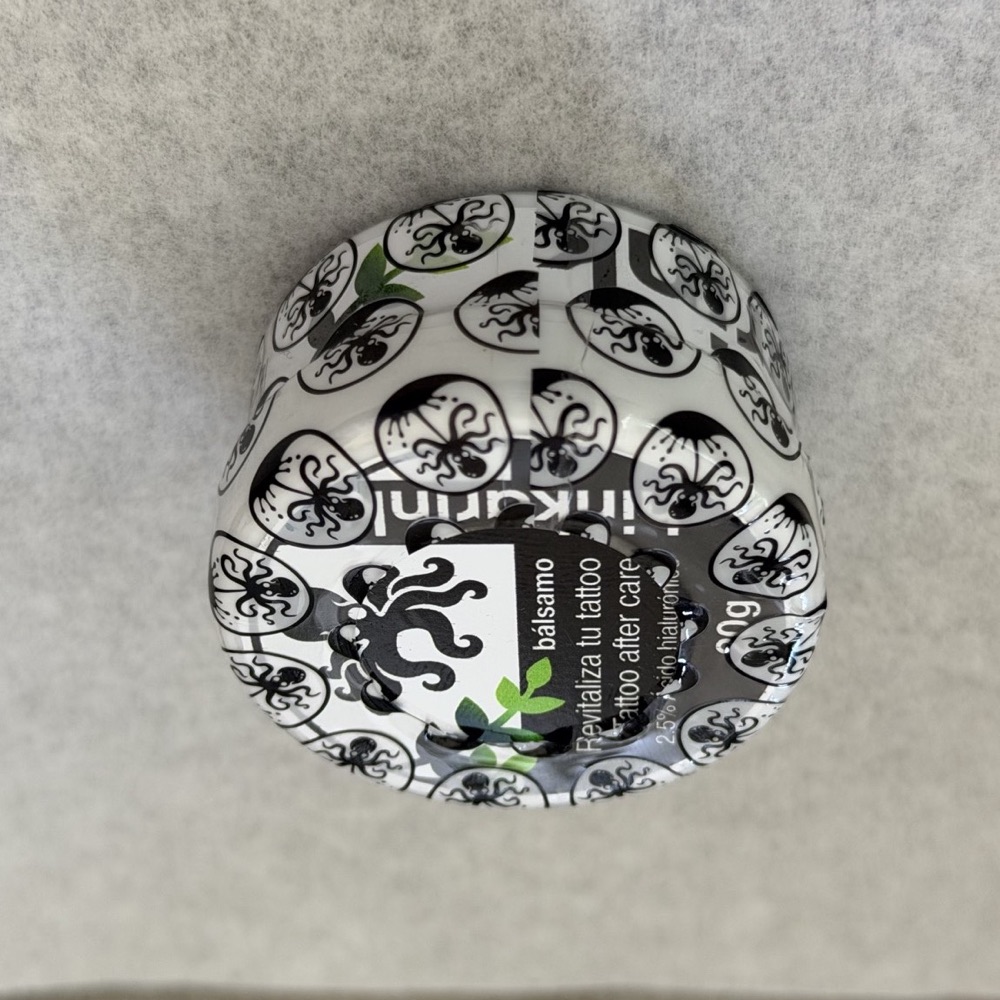 $150 MXN
Hinkarink balm
It is the one on our counter and the one we recommend on your way out. A 20 g tattoo-specific balm with 2.5% hyaluronic acid.
- No petrolatum. Right above is the American Academy of Dermatology warning: petroleum jelly and its derivatives can fade the ink. The maker states this balm is 100% natural in origin and petrolatum-free, which is exactly what you want.
- Hyaluronic acid holds water — up to a thousand times its own volume — and keeps the moist environment skin needs to close without cracking.
- It does not leave skin greasy or mark your clothes, so you can put it on and go.
- Balm texture: it spreads in a thin layer and lasts. One 20 g tin covers a full medium piece.
Something not looking like it says here?
Send us a photo on WhatsApp. We would much rather look at it and tell you all is well than have you sit on it for a week assuming it is normal.
None of these instructions are our own invention. Here are the sources, in case you want to read them in full: